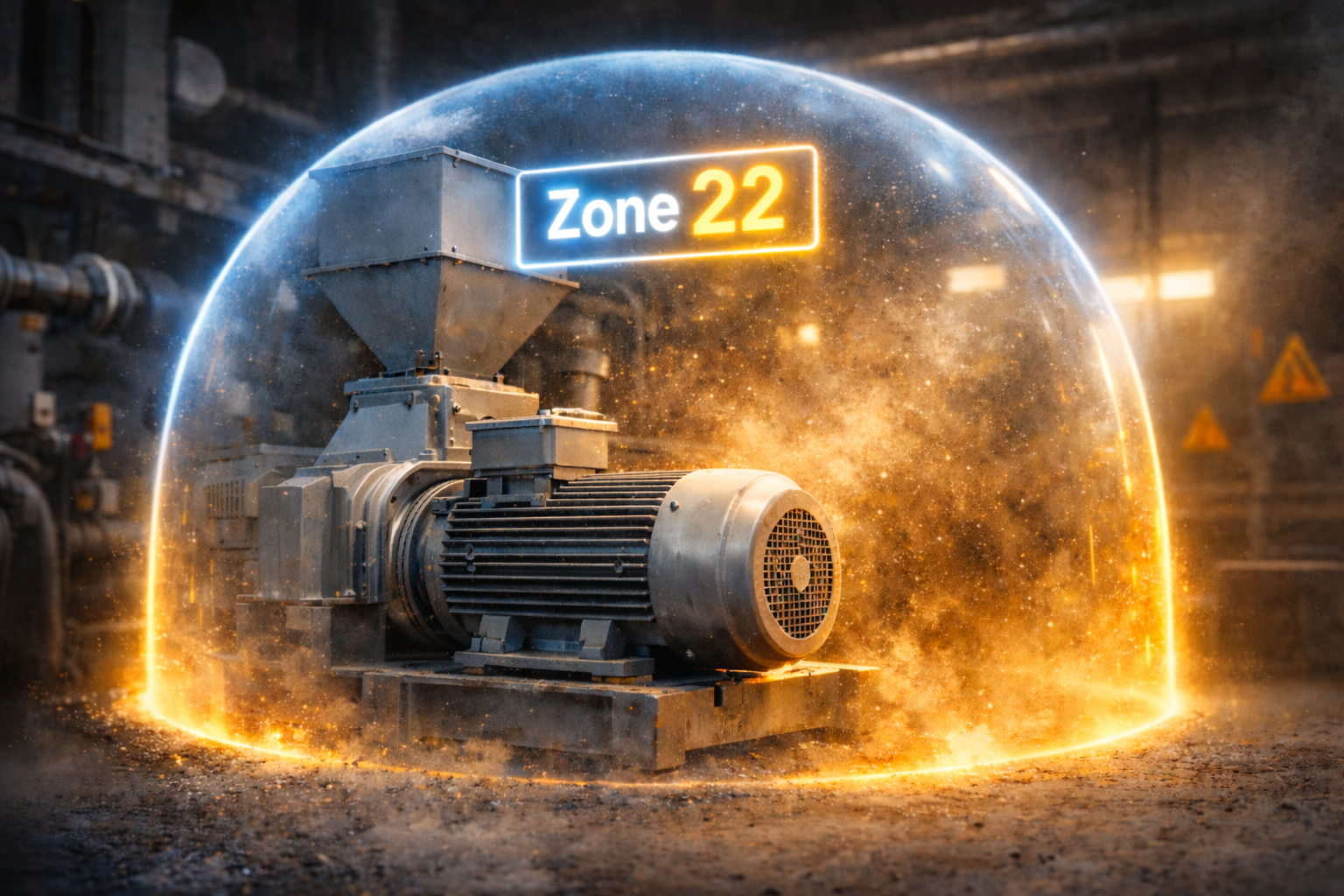
What does “Zone 22” mean?
When dust is present in the air and can ignite under certain conditions, this is referred to as an explosive atmosphere. Within the explosion protection guidelines (ATEX), areas are classified according to how often and for how long such atmospheres can occur.
Zone 22 refers to areas in which an explosive dust atmosphere does not normally occur, but may arise briefly in the event of a fault or malfunction – for example, due to dust being stirred up during cleaning work or dust deposits being set in motion.
Many modern risk assessments now take this scenario into account much more than in the past. Dust deposits on machines, in corners, or on motor fan covers are therefore not only “visually unpleasant,” but can also become relevant in terms of standards if they enable the formation of an ignitable dust cloud.
Why is Zone 22 so relevant today?
There is no “new legal text just for Zone 22.” What is decisive is that the state of the art in explosion protection has evolved—and this is increasingly being taken into account in audits, inspections and risk assessments.
In practice, this means that
- Standards and guidelines now require even small dust releases and dust deposits to be included in the risk assessment.
- During inspections, it is expected that the zone classification is justified in a comprehensible manner – not just based on experience or “because nothing has happened so far.”
- If an area is classified as Zone 22, the ATEX product requirements for electrical equipment apply there, i.e., appropriately certified motors and electrical equipment.
For maintenance personnel, this often creates a conflict between historically grown installations (with standard IEC motors) and today’s documentation and verification requirements. This is exactly where expert advice helps to turn uncertainty into reliable decisions.
What does this mean for your motors?
Around ten years ago, standard IEC motors were often used in dust-exposed areas. As long as a plant was not explicitly classified as potentially explosive, dust deposits on motor hoods, fan grilles or terminal boxes were often considered an operational issue rather than a safety issue.
With the further development of the ATEX system and international standards from April 2016, this picture began to change. Dust atmospheres were considered more systematically and Zone 22 developed from a marginal consideration to a regular Ex zone with clear equipment requirements.
This development has continued in recent years, particularly with the current editions of EN IEC 60079-31:2024 (dust protection by enclosures). Among other things, these specify requirements for dust-tight enclosures, permissible surface temperatures, and terminal boxes and cable glands – especially for equipment in Zone 22 with EPL Dc.
At the same time, the standards IEC 60079-17:2023 (inspection and maintenance) and IEC 60079-14:2024 (selection, installation and initial testing) were updated. In practice, this means that the ATEX approval of a motor, its labeling and its inclusion in the documentation must now comply with the current state of the art.
This trend became even clearer with the revision of the German TRGS 722 in 2025. It emphasizes that even small dust deposits and the possibility of them being stirred up during malfunctions or cleaning work must be included in the risk assessment. In case of uncertainty, a conservative assessment should be made.
In many plants, this means that Zone 22 is now applied more frequently than in the past as a realistic result of modern risk assessments.
For electric motors, this development has a clear consequence:
A standard IEC motor in accordance with IEC 60034 or IEC 60072 may still be mechanically suitable. However, if the area of application is classified as Zone 22, it no longer meets the requirements of IEC 60079-10-2, the ATEX Product Directive 2014/34/EU, and the ATEX Operating Directive 1999/92/EC without ATEX certification.
Similar to the introduction of new efficiency classes (e.g., IE4), the following applies: Old technology can continue to be used, but it no longer automatically complies with the current state of the art.
In a confirmed Zone 22, the audit-proof standard is therefore an ATEX-certified Ex motor.
The path to a reliable decision
For maintenance personnel, this means in practice:
- Check the zone classification: Where dust can be released or deposited, it should be checked whether Zone 22 applies according to current methodology.
- Select suitable ATEX motors: For Zone 22, Ex motors with dust protection (e.g., Ex-t enclosures) are available in sizes comparable to standard IEC motors.
- Consider documentation: Ex marking, technical documentation, and test reports must be available in full.
- Consider operating concepts: Inverter operation, temperature monitoring, and protective functions influence the Ex approval and must also be taken into account.
This turns what was often a “soft assessment” in the past into concrete, verifiable explosion protection certification.
Tip from practice: Retrofit instead of risk
In many cases, a standard motor can be replaced by an ATEX-compliant motor of the same size without costly mechanical modifications. Modern Ex motors are often mechanically compatible – similar to replacing older motors with more efficient IE classes.
This saves costs, reduces risks, and brings your system up to the current state of the art.
See dust – act correctly
Dust is always an indication of potential risk. Whether this actually results in a Zone 22 is determined by the risk assessment. In many companies today, dust zones are identified more frequently and more clearly than in the past.
Standard motors, even if they are mechanically compatible, do not automatically meet these requirements. You should therefore check your drive technology together with a competent partner. The sales engineers at MOLL-MOTOR will help you select suitable, ATEX-certified motors – so that safety and documentation are up to date for the 2020s.